



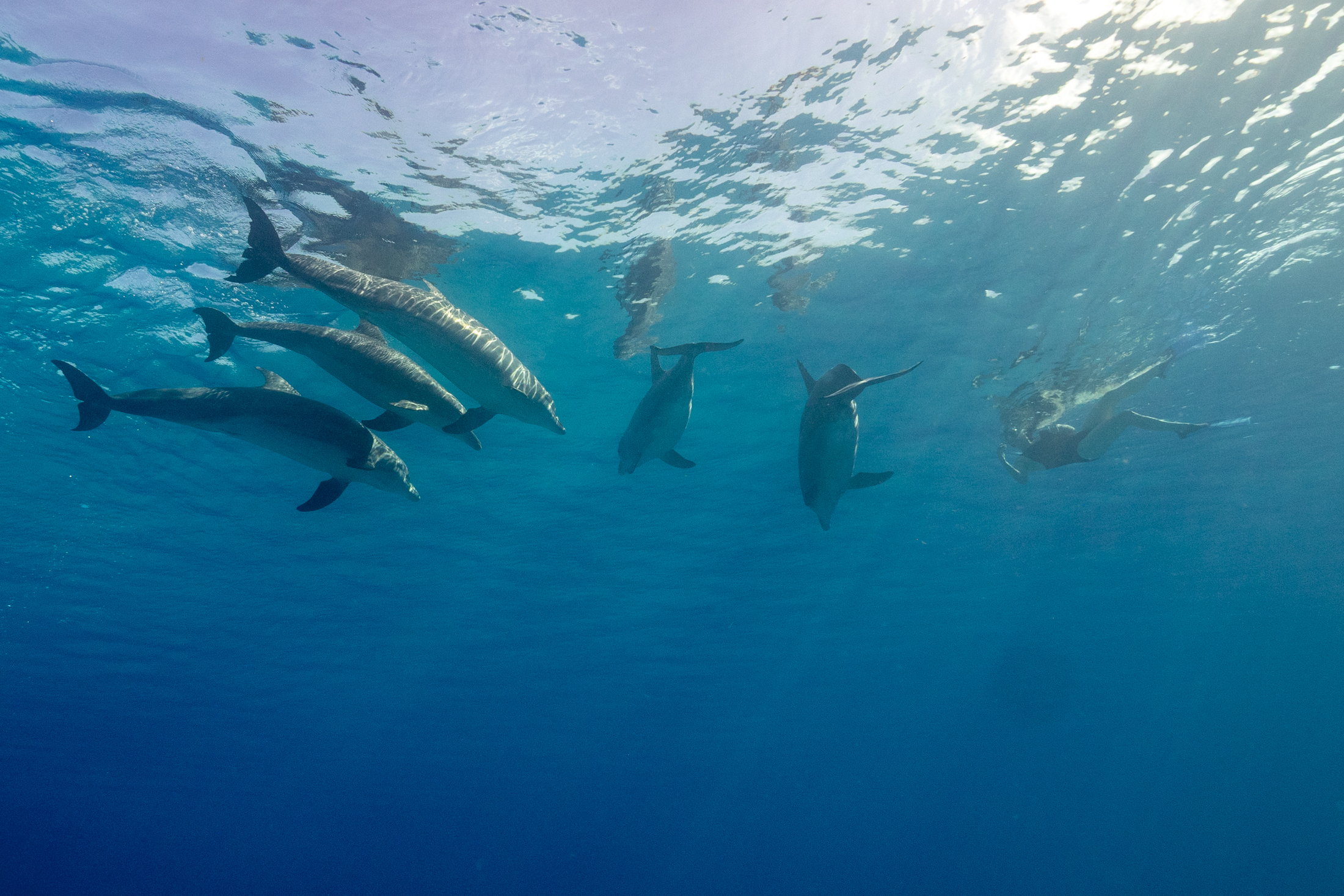
19 Oct Is Swimming with Dolphins Harmful? yes, no, and all the nuance in between.
REFLECTION | IN-WATER ENCOUNTERS
By Stephanie Huguenin-Elie – Sustainable Dolphin Watching Guide – Founder of Dolphin Whisper
Swimming with wild dolphins is not harmful in itself. It becomes harmful when we take the choice away from them: when we chase them, crowd them, interrupt their rest or come too close to a young calf. Here is where the line lies, how to recognise when it has been crossed, and how to be a guest in their world rather than an intruder.
A question I am asked on almost every trip
“Is it bad to swim with dolphins?” I hear it on deck, often in a low voice, sometimes with a mask already in hand.
I understand the question, and I love that it is asked. It means the person in front of me already senses that something is at stake. That the encounter they dream of is not only about them.
My honest answer is never a simple yes or no. It is: it depends. On the dolphins, on the moment, on the people in the water. And above all, on whether the dolphins are still free to choose.
It is not the swim that matters. It is who decides.
So, is swimming with dolphins harmful?
Yes, it can be. And it does not have to be.
Twenty-five years of research tell a consistent story. Where swim-with tourism is intense, poorly managed or constant, dolphins rest less, avoid swimmers more over time and can be pushed away from the places they need. Where encounters are rare, calm, well managed and led by the dolphins, the impact can be kept low.
The difference rarely lies in the activity itself. It lies in the way we enter their world.

When is the answer no?
Swimming with dolphins can be respectful when a few conditions come together.
The dolphins are wild and free to leave at any moment. They are not resting, not feeding intensely, and there is no very young calf in the group. Only a few quiet swimmers are in the water, for a limited time. The boat has approached slowly, from the side, and has not chased anyone. And the dolphins themselves come closer, stay, circle, look, and decide how long the encounter lasts.
Those are the moments when something rare can happen: curiosity meets curiosity. In New Zealand, a long-term study found that juveniles were more likely than adults to interact with swimmers. In the Bahamas, the Wild Dolphin Project has spent decades observing Atlantic spotted dolphins from the surface, joining their games only when the dolphins start them.
That is the key: the dolphins start.
A respectful encounter is an invitation, never a pursuit.
When is the answer yes?
Swimming with dolphins becomes harmful when the encounter is imposed on them.
When dolphins are resting. Many dolphins rest during the day, often in sheltered bays. Spinner dolphins are the clearest example: they feed offshore at night and come into shallow bays to rest. Off Hawaii Island, researchers found that spinner dolphins had people within 100 metres for about 82% of the daytime, with a new exposure roughly every ten minutes. Since October 2021, it has been illegal in Hawaii to swim with or approach spinner dolphins within 50 yards, about 45 metres.
In the Egyptian Red Sea, a study at Samadai and Sataya found a strong drop in resting behaviour where boats and swimmers were present, compared with a site without tourism. At Samadai, where zoning keeps swimmers out of a dolphin-only area and limits the hours, daily interaction time was roughly halved.
What else crosses the line?
When there is a very young calf. A newborn depends on its mother for everything, even the rhythm of its breath. Swimmers who come between them, or who put pressure on the group, add stress at the most fragile moment of its life. In New Zealand, the regulations do not allow swimming with pods that include very young calves.
When we chase, surround or cut them off. Dropping swimmers in the path of travelling dolphins, circling them with a boat or following them when they turn away all take the choice from them. In New Zealand’s Bay of Islands, avoidance of swimmers grew over the years, and grew most when swimmers were placed in the dolphins’ path.
When it happens all day, every day. One swim may seem harmless. But dolphins in a popular bay do not meet one group of swimmers. They meet all of them. In the Bay of Islands, after a steep fall in the number of dolphins using the bay, New Zealand’s Department of Conservation stopped swimming with bottlenose dolphins there in 2019.
When we touch or feed. Touching can pass diseases in both directions and can end in a bite or a blow. Feeding changes behaviour, draws dolphins towards boats and people, and puts them at risk.
One swim is never just one swim. For the dolphins, it is the sum of all of them.
Why is the harm not always visible?
This may be the most important thing I have learned: a dolphin that stays near swimmers is not necessarily a dolphin that is fine.
Sometimes dolphins tolerate us because the bay they rest in is the only safe one nearby. In Hawaii, researchers did not measure a drop in resting despite near-constant exposure, and still warned that it could lead to rest deprivation and push dolphins out of their preferred bays over time.
The cost is often hidden: a shorter rest, a little more energy spent, a calf that nurses less. Invisible in one morning. Heavy over a season.
So respect cannot depend only on what we see in the moment. It also depends on what we know.
How do you know when the line has been crossed?
Dolphins speak with their bodies. Learning to read them is the most precious skill a swimmer can have. These are the signs I watch for.
They turn away. The group changes direction, speeds up, or surfaces further away each time. It is the most common message, and the clearest: not now.
They dive longer and come up elsewhere. Long, unpredictable dives after people enter the water often mean the dolphins are trying to avoid them.
The group tightens. The dolphins pull closer together and move as a block. A mother may place herself between the swimmers and her calf, or the calf may tuck in close beneath her.
They strike the water or make sharp sounds. Tail slaps, head slaps, sudden bursts of bubbles, jaw claps or a stiff, arched body are signs of irritation or threat. When you see them, it is time to move away calmly.
They are resting. Slow, regular swimming, a tight group, quiet surfacing in rhythm, very little activity. This is not an invitation. It is a closed door, even when the dolphins are right beside the boat.
They simply don’t come. If the dolphins keep their distance, that is their answer. It deserves the same respect as a yes.
And there is a sign inside us too. The moment we notice ourselves kicking harder, reaching out, swimming after them “just for one more second”, the line is already behind us.
When we start to chase, even gently, the encounter is already over.
How should you behave in the water with dolphins?
Before you go, choose your operator. Look for one who works within local rules and permits, gives a briefing before anyone gets in, never guarantees a swim, limits the number of swimmers and the time in the water, and is ready to leave a group that is resting or has a newborn. A good operator is not judged by how close you get, but by the moments they choose not to stop.
Enter quietly. Slip in from the side or the back of the boat, without jumping or splashing. Never in front of a travelling group.
Stay at the surface, and stay together. Float, breathe slowly, keep your arms by your sides or folded, and move gently with your fins. Stay close to the other swimmers, so the dolphins see one calm group rather than a crowd surrounding them.
Let them choose the distance. Don’t swim towards them, don’t follow, and never dive down onto them from above. If they come closer, stay calm and keep your place. If they leave, let them go.
Never touch, never feed. Even when a dolphin comes very close. Especially then.
Keep the silence. No shouting, no whistling, no underwater scooters. Keep your camera close to your body: the picture is never more important than the moment.
Get out when it is time. Respect the time limits and leave the water when your guide asks, without negotiating. The best encounters end while the dolphins are still calm.
Be a guest in their world, not a spectator at a show.
What about swimming with dolphins in captivity?
Here my answer is clear. For me, swim-with programmes in pools or sea pens are not a respectful encounter.
Everything that makes an encounter in the wild acceptable is missing: the freedom to leave, the choice to come closer, a life lived on their own terms. Organisations such as World Animal Protection have documented the welfare cost of these programmes, and I explain why captivity is harmful for dolphins in another article. I believe the most loving thing we can do for these dolphins is not to book them.
What does it mean to be invited?
I have spent many hours at sea with dolphins, and the moments that stay with me are rarely the ones I went looking for.
In Sataya, in the Red Sea, I watched spinner dolphins trying to rest in the bay while engines and swimmers kept coming, all day long. Some swimmers pushed towards them again and again. Others had listened to a few simple words before getting in. They floated quietly, let the dolphins pass, and still came out of the water with shining eyes. That difference never left me. It showed me that respect is not only a matter of good intentions. It is a matter of knowing.
I have learned something about myself too. I feel the pull towards dolphins very strongly. For a long time, I believed that wanting something deeply was reason enough to go after it.
The sea taught me otherwise. When I stop reaching, stop swimming after them and simply float, breathing, open, available, something changes. Sometimes nothing happens. And sometimes a dolphin turns, comes back, and looks at me. Then I know the moment is real, because it was not taken. It was given.
I believe this is true far beyond the sea. The most beautiful things in my life did not come when I forced them. They came when I was present, and ready to respond.
So, is it harmful to swim with dolphins? It is, when we make the decision for them. It is not, when we leave it to them.
The most beautiful encounter is the one they choose.
Stéphanie Huguenin-Elie
Founder of Dolphin Whisper and advocate for ethical dolphin encounters.
www.dolphinwhisper.com – Ethical dolphin encounters
Further reading
World Animal Protection (2019). Behind the smile: the truth about dolphins in entertainment.
Wild Dolphin Project. Working with wild dolphins.
Frequently asked questions
Is it ethical to swim with wild dolphins?
It can be, when the dolphins are free to leave, are not resting or with a very young calf, and the encounter is calm, short and started by them. It is not ethical when dolphins are chased, crowded, touched, fed or disturbed while they rest.
How close can you swim to dolphins?
It depends on local rules. In Hawaii, approaching spinner dolphins within 50 yards (about 45 metres) is illegal. Elsewhere, the best rule is to let the dolphins set the distance: never swim towards them, and let them leave whenever they want.
How do you know if a dolphin is stressed by swimmers?
Common signs include turning away, swimming faster, longer dives, a tighter group, a mother shielding her calf, tail or head slaps and bursts of bubbles. Any of these means it is time to give the dolphins space.

No Comments