

10 Jun Why Captivity Is Harmful for Dolphins : Beyond the illusion of the “happy dolphin”
Why Captivity Is Harmful for Dolphins :
Beyond the illusion of the “happy dolphin”
Why is captivity harmful for dolphins? Discover how confinement affects their space, social bonds, stress levels, and overall welfare and why dolphins belong in the wild.
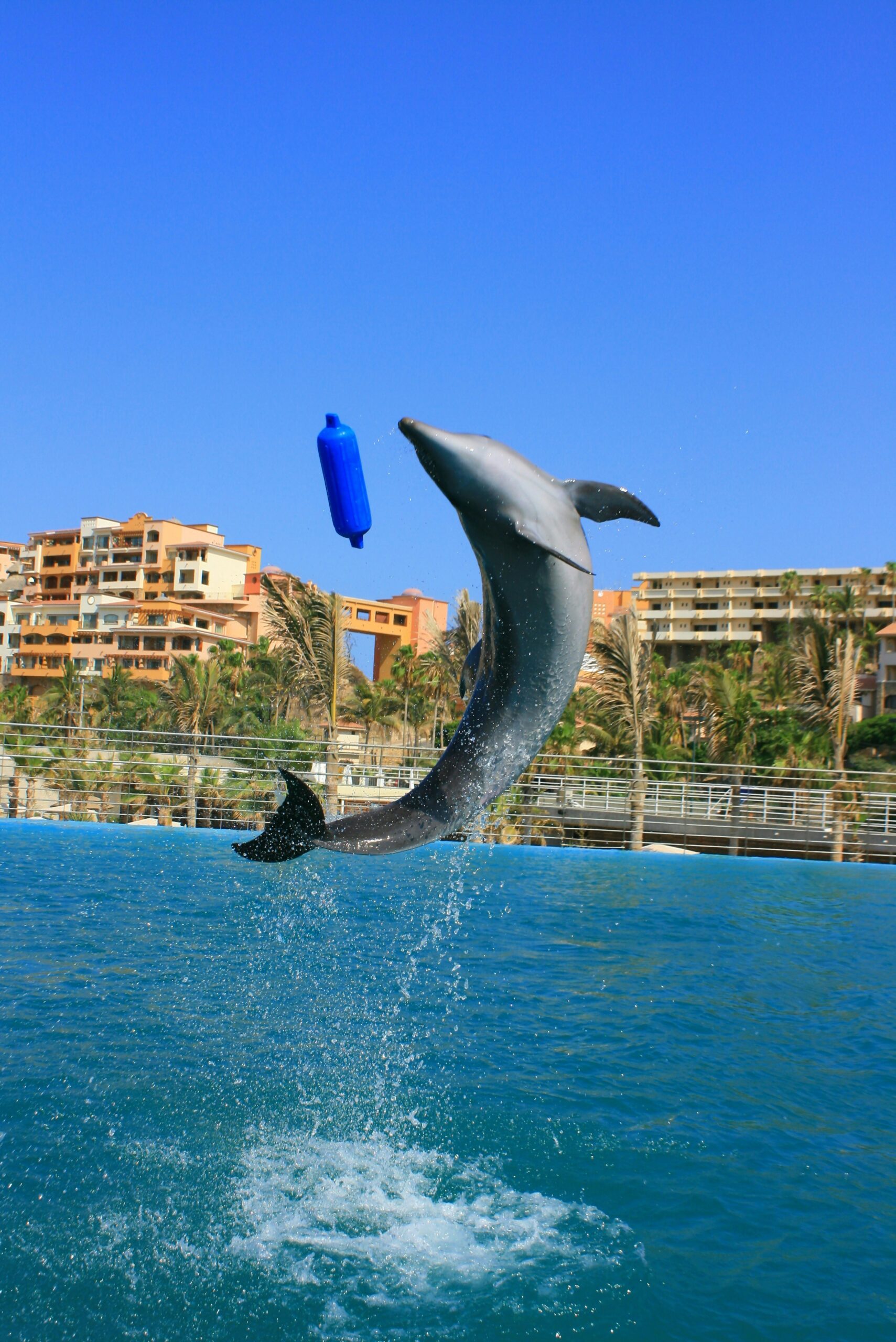
For many people, dolphins in captivity seem playful, calm, and even happy. They jump, interact with trainers, and appear to live comfortably in the world we have created for them. But when we ask honestly why captivity is harmful for dolphins, we have to look beyond appearances. Dolphins are highly intelligent, socially complex, wide-ranging marine mammals, and current welfare reviews describe serious and persistent problems linked to confinement, altered social conditions, restricted space, and chronic stress in captivity.
At Dolphin Whisper, this question matters because captivity has shaped more than the lives of dolphins — it has shaped the way humans imagine them. For decades, we were given a familiar story: dolphins are smiling performers, naturally eager to please. But that story was never theirs. It was ours. And before we can understand what captivity does to dolphins, we have to be willing to question the comforting illusion that made captivity seem normal in the first place.
Dolphins are made for the ocean, not for tanks
Dolphins do not simply live in the sea. They are shaped by it. In the wild, they travel through vast and changing environments, dive through different water layers, navigate complex acoustic landscapes, and live within rich social systems. Some wild dolphins can travel up to 100 kilometres a day in the open ocean.
Scientific reviews on captive cetacean welfare emphasise the contrast between the restrictive nature of captive facilities and the dynamic, multifaceted nature of the natural environment. Even when conditions improve, captivity still falls far short of providing what dolphins need physically, socially, and cognitively.
A tank may keep a dolphin visible. It does not give that dolphin a full life.
Because the ocean is not just “more space”. It is choice, depth, unpredictability, movement, sound, and relationship. It is the environment dolphins evolved to understand.
Captivity creates chronic stress
One of the clearest answers to the question “why is captivity harmful for dolphins?” is stress. Welfare reviews describe significant ongoing concerns related to behaviour, physical health, reproduction, and long-term well-being in captive cetaceans. They also point to the clinical, behavioural, and neural consequences of confinement.
Stress in dolphins is not always obvious to visitors. It may appear as repetitive behaviour, withdrawal, aggression, or a gradual loss of vitality. Some sources focused on captive dolphin welfare also report behaviours linked to frustration and self-harm, as well as the use of medication in some facilities to help manage the effects of captivity.
What makes this especially troubling is that dolphins are not passive animals. They are responsive, intelligent, emotionally aware beings. When such a being is placed in a reduced, repetitive, controlled environment, the pressure may not always be visible, but it is deeply real.
Dolphins lose the social lives they depend on
Dolphins are profoundly social animals. Their lives are built around communication, cooperation, learning, and long-term bonds. Family members can stay together for years, and pod life plays a central role in how dolphins navigate the world.
Captivity disrupts this. Dolphins may be separated from familiar companions or placed in artificial groupings that do not reflect natural relationships. Welfare and advocacy sources describe aggression, social instability, and physical evidence of conflict, such as rake marks, as recurring concerns in captive settings.
In the ocean, a dolphin can leave a tense interaction. In captivity, there is nowhere to go.
This matters because social life is not an optional extra for dolphins. It is part of their survival, identity, and well-being.
Captivity affects both mind and body
Captivity does not only limit movement. It also affects health. Welfare reviews identify persistent concerns involving captive space, feeding, physical health, reproduction, and lifespan in cetaceans kept in confinement.
Other sources describe additional issues reported in some facilities, including shallow enclosures, overexposure to sunlight, eye irritation, lesions, and disease-related concerns when environments are poorly maintained.
These details may vary from one facility to another, but together they point to the same reality: captivity creates conditions that dolphins did not evolve for.
Intelligence makes captivity harder, not easier
Dolphins are often admired for their intelligence. But that intelligence is one of the very reasons captivity can be so harmful. Research reviews describe cetaceans as highly intelligent, wide-ranging, and socially complex animals, precisely the kind of beings for whom confinement raises serious welfare concerns.
An intelligent animal does not thrive simply because it is fed and kept alive. Welfare is about more than survival. It is about stimulation, meaningful relationships, natural behaviour, exploration, and agency.
Captivity offers care, but it cannot offer the full experience of being a dolphin.
And for a mind built for complexity, that loss is not small.
The myth of education and conservation
Captivity is often justified in the name of education or conservation. But critical analyses of the marine mammal display industry argue that captive breeding programmes often focus on non-endangered species and do not meaningfully support wild populations. In many cases, breeding helps sustain captivity itself rather than protecting dolphins in the wild.
Education is also more limited than it appears. Watching trained behaviours in a controlled environment does not teach us what dolphin life really is. It shows us what dolphins do inside a system of confinement. That is not the same as understanding their true nature.
When education is built on distortion, it does not deepen respect. It risks reinforcing illusion.
So why is captivity harmful for dolphins?
Because captivity removes the very conditions dolphins need in order to thrive.
It replaces:
freedom with control
movement with boundaries
complexity with monotony
natural social life with imposed structure
Research on captive cetacean welfare continues to identify serious welfare challenges despite efforts to improve some facilities.
Dolphins are not harmed by captivity because they are fragile. They are harmed by captivity because they are too intelligent, too social, too ecologically specialised, and too deeply adapted to the ocean for tanks to ever be enough.
A more honest way to care
At Dolphin Whisper, the goal is not only to question captivity. It is to invite a different relationship with dolphins altogether — one based on understanding, humility, and respect.
Because the real question is not simply: Can dolphins survive in captivity?
The real question is: Can they truly live there?
If we care about dolphins, the answer is not to bring them closer to us through confinement. It is to protect the living oceans they depend on, support ethical wild encounters, and learn how to meet them without taking anything away.
Dolphins do not need tanks to be understood. They need freedom to remain who they are.
Want to meet dolphin in a way that protects their feedom ?
Explore Dolphin Whisper’s educational guides and ethical travel resources, and learn how to encounter without disturbing their world.
Written by Stéphanie Huguenin-elie,
Marine guide and founder of Dolphin Whisper.
With years of experience observing dolphins in the wild, I share a conscious approach to human–dolphin encounters based on respect and understanding.

No Comments